
Does the Kornet Kontest Work?
Luke Kornet's Eclipse is a fan favorite, but is it effective?

Howdy folks,
This post is too long for email so click the title at the top to view the full thing in your browser. Or you can jump to the results if you’re short on time.
The NBA in August gives way to rest and relaxation. A chance to unplug from hoops before things pick back up after Labor Day. But if you’re a basketball sicko like me, this downtime provides the perfect opportunity to dig into oddball topics that don’t fit into the in-season news cycle.
For example, the Kornet Kontest.
For the uninitiated, Luke Kornet has been performing an unusual defensive maneuver for the past few years. When an opposing player spots up beyond the three-point arc and Kornet is too far away to contest the shot in a traditional manner, he will jump straight up in the air and use his length to obscure the view of the basket. It’s playfully referred to as the Kornet Kontest or, as the inventor himself likes to call it, the Eclipse.
Even while standing in the paint, Kornet’s 9'6" standing reach can obscure the view of the rim. It’s difficult to tell from the broadcast angle what it looks like from the shooter’s perspective, but Todd Whitehead from Sportradar took a crack at illustrating it.

In the past couple of years I’ve begun to notice other players around the league copying Kornet’s creation.
Victor Wembanyama, Kornet’s new teammate in San Antonio, has shown a willingness to give it a go.
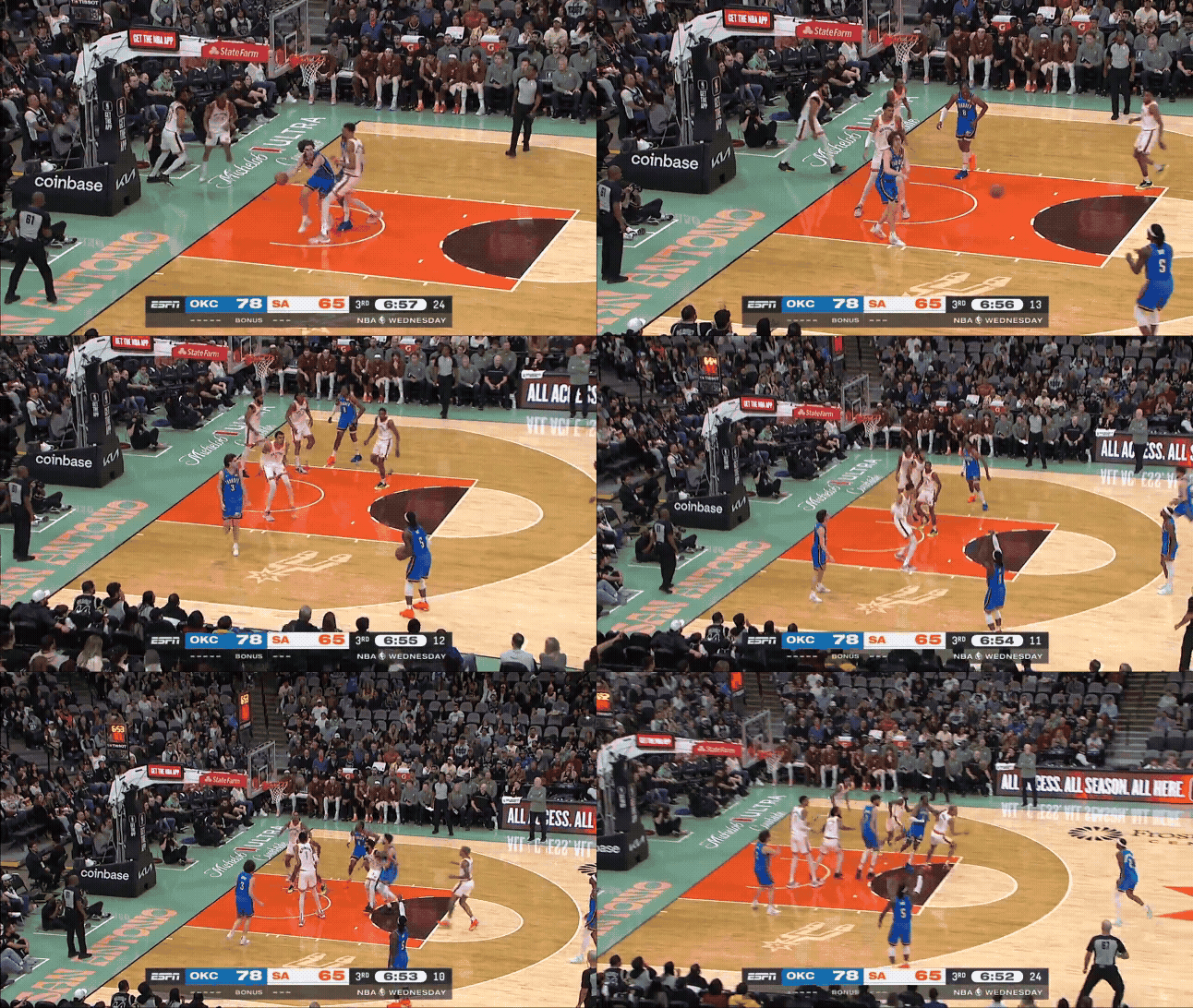
As has Mark Williams, another member of First Team All Standing Reach.
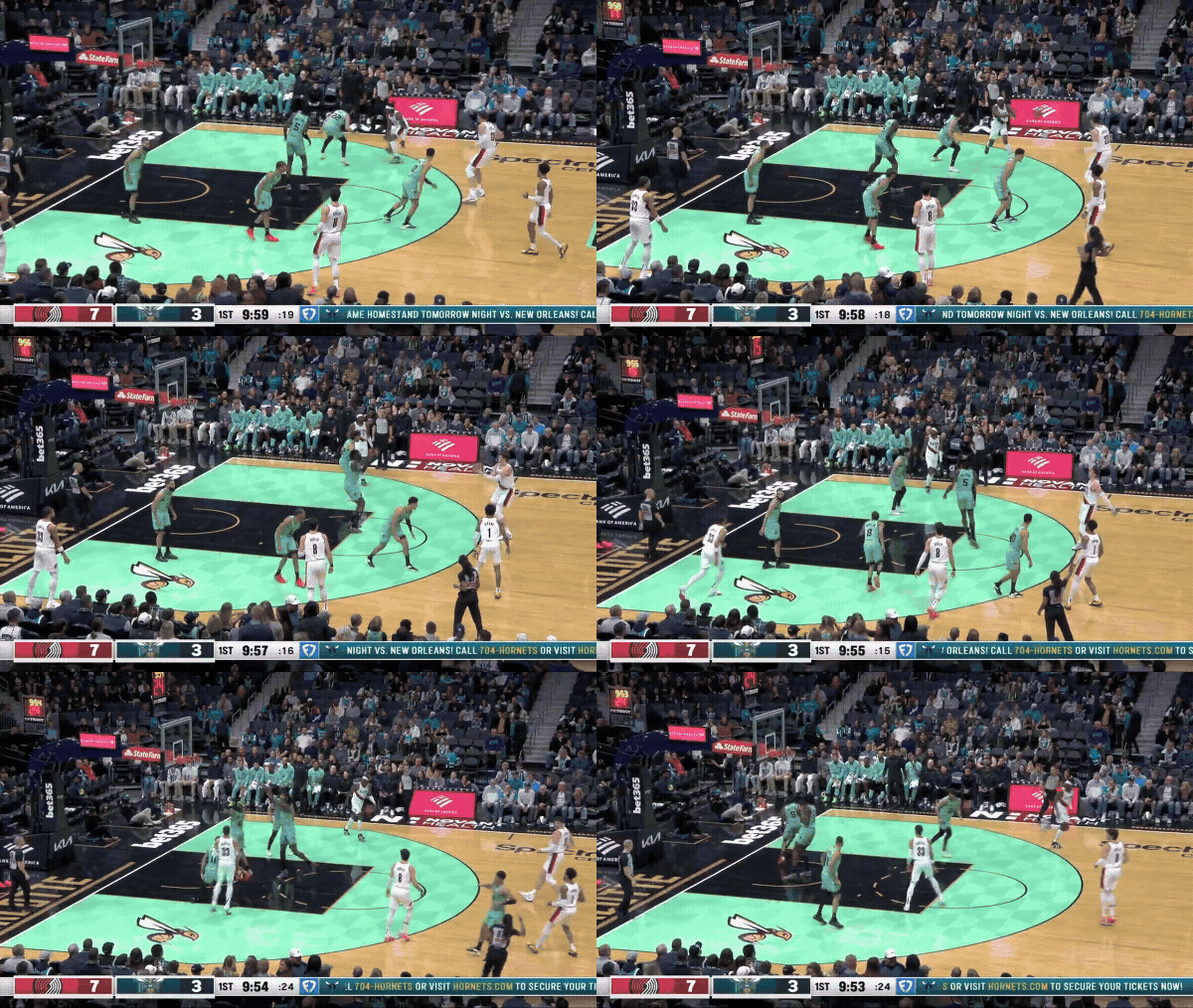
Mavericks forward P.J. Washington does it.
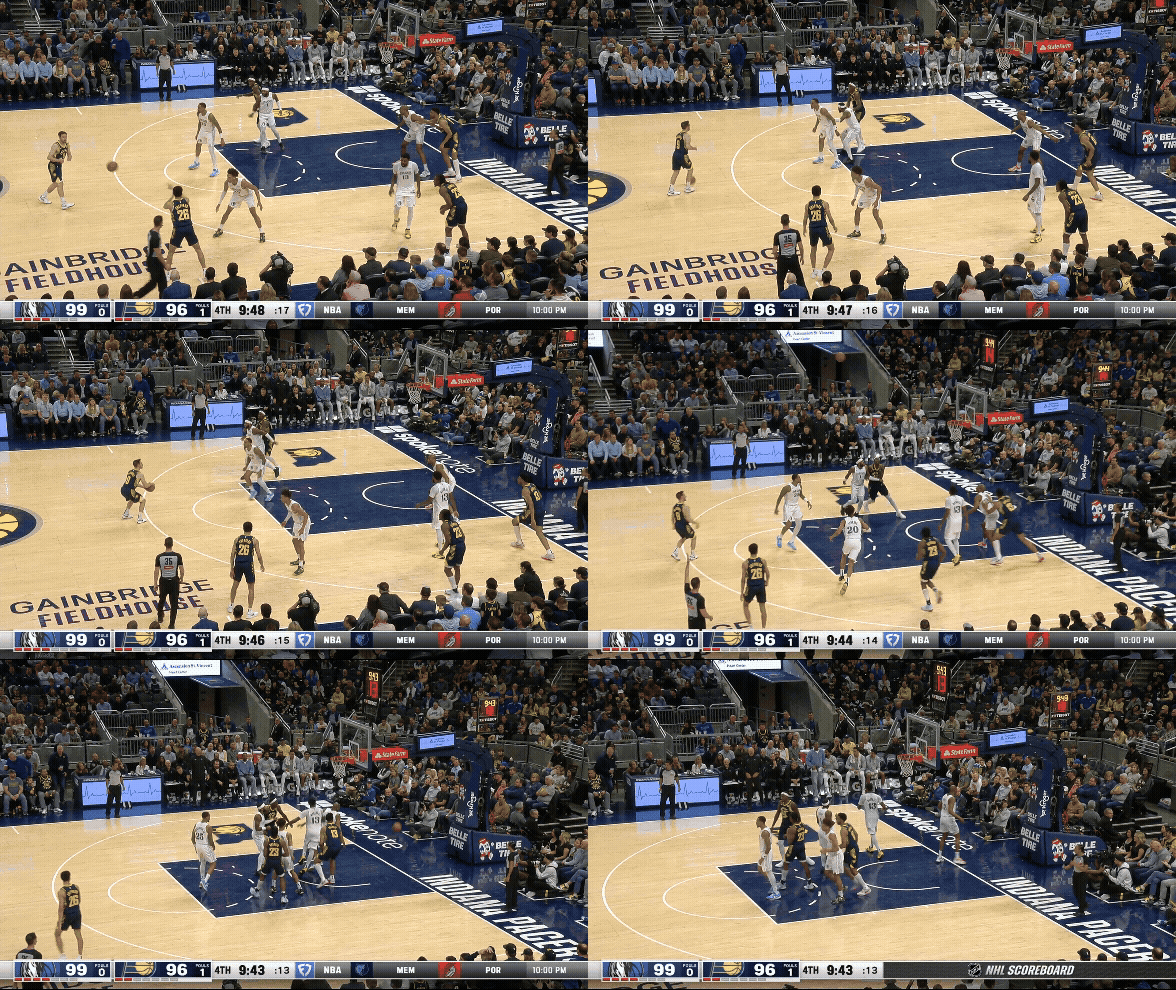
So does tiny Trae Young.
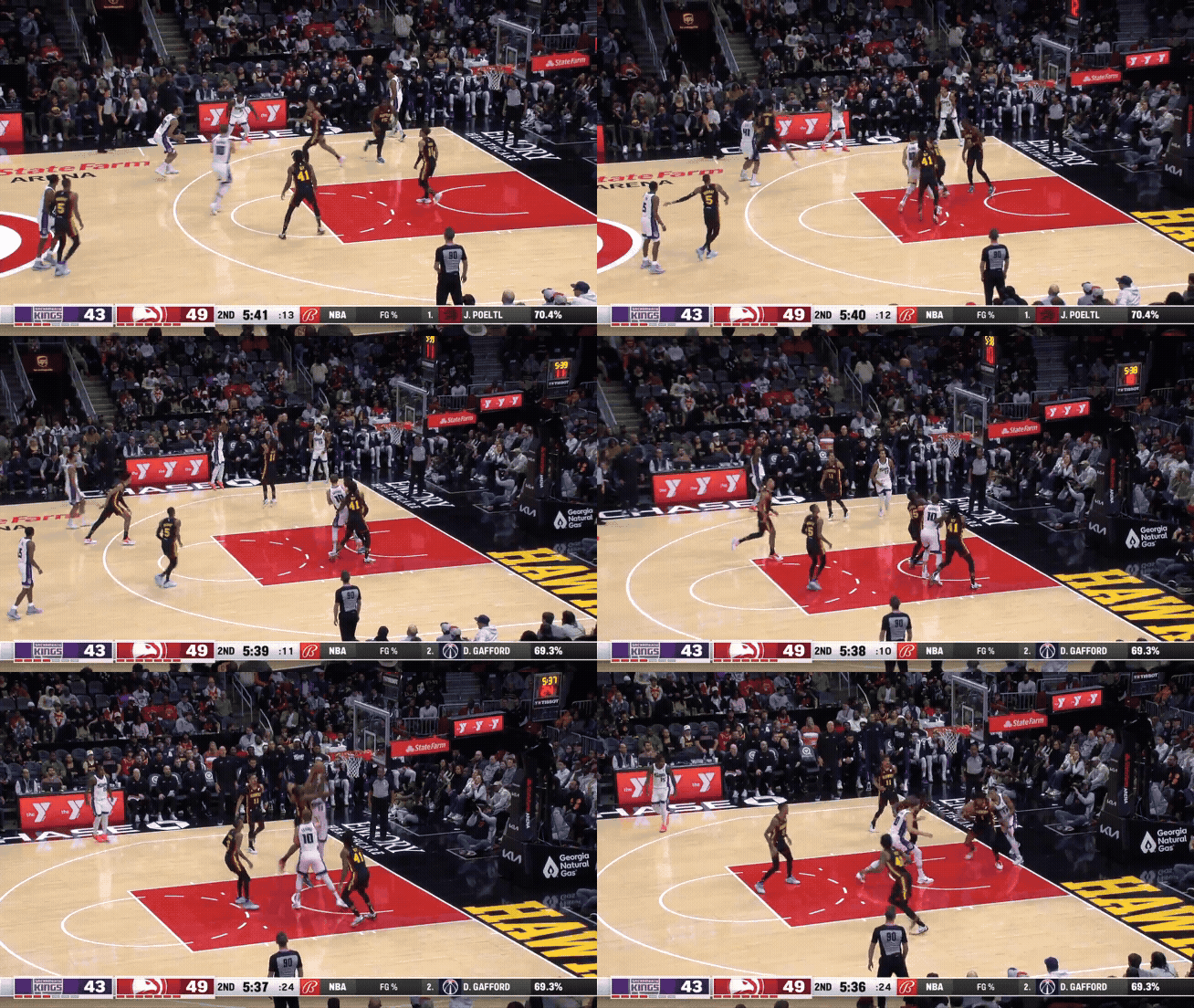
Even ground-bound players like Luka Doncic have tried it out.
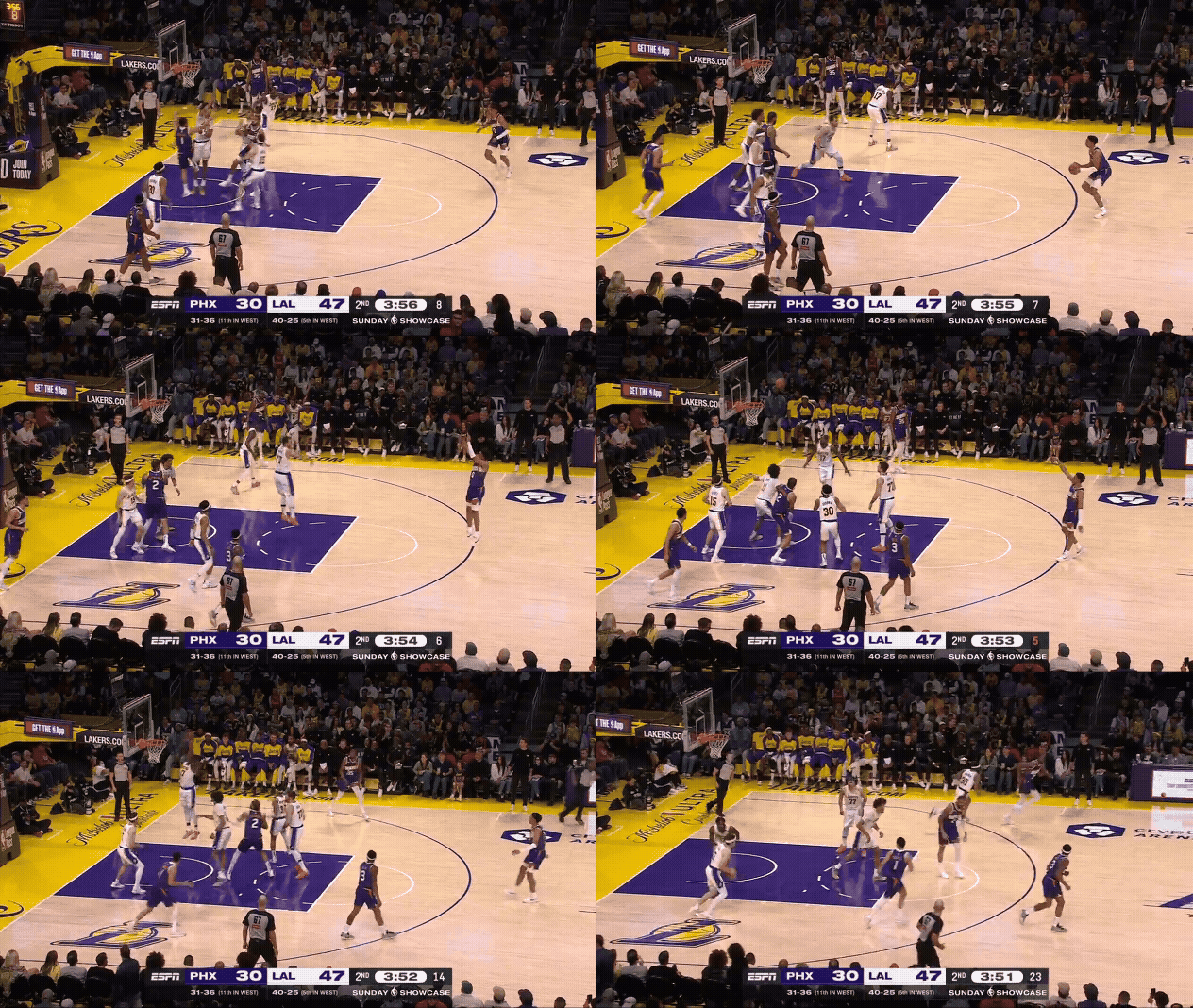
With the Eclipse seemingly sweeping across the league, I thought it was high time for someone to do the dirty work and find out the truth: Does the Kornet Kontest work?
Need More n
I have seen some attempts to quantify the impact of the Eclipse, but all of them have left me unsatisfied for the same reason — lack of sample size.
In 2022, Jared Weiss wrote an excellent piece titled, ‘For Celtics’ Luke Kornet, contesting 3s from the paint has method in its madness’. Weiss’ story provided ample details on Kornet’s motivation for the Eclipse, but there wasn’t much in the way of evidence of its effectiveness.
Here’s what Weiss wrote in The Athletic:
At 7-foot-2, Kornet can make that rim vanish behind his reach for the sky. Contesting a shot isn’t about blocking it, but taking the shooter out of their comfort zone. The Kornet contest is throwing guys off just enough to work.
“As a big, I’m not like a lot of our guys who are super fast and can close out and stay in front, really make incredible plays,” Kornet said. “So it’s like, I’m really tall, so how can I be effective in that? I just figure it out because the game forces you to. So it works.”
The results: 2-for-8 shooting in three games so far, with one turnover by Evan Mobley and an and-1 by Rui Hachimura.
Shortly after Weiss’ story, the YouTube account Heat Check published a video on the same topic titled, ‘The Entire NBA Laughed At His Defense, BUT THEN...’
The video is a masterclass in YouTube clickbait and has been viewed close to two million times. However, it runs afoul of the same small sample size problem as Weiss’ original reporting.
From the video’s transcript:
According to my tracking numbers, so far this season Kornet used the eclipse on 12 shots from downtown. And only 3 of those went in. As you can see, these are considered wide open shots. There’s literally nobody around. So to shoot 25%, that’s horrific, and it leads me to believe that the Celtics big man is onto something.
And then in December 2022, Tim Bontemps published a piece of his own for ESPN titled, ‘Why Luke Kornet's Contest is effective for the Celtics.’
Bontemps gave readers the first taste of something resembling a meaningful sample size, but it was still far from robust.
Here’s what Bontemps wrote:
This season, ESPN Stats & Information tracked Kornet performing the move on 36 shots -- including 34 3-pointers -- with opponents making 12 shots for a 33.3% success rate. According to Second Spectrum player tracking data, Kornet was the closest defender on 22 of those 36 shots. (Per Second Spectrum, the NBA average on wide-open 3s is 38.0%.)
Even if we take all the reporting at face value and disregard the lack of sample size, there’s an issue in that all these stories were published between November and December of 2022. We don’t know if Kornet was just on a hot streak or whether it maintained its effectiveness as opponents got used to seeing it.
In his book, Basketball Beyond Paper, Dean Oliver wrote about how the Wizards tested the effectiveness of the Eclipse in practice and how players responded to it over time:
We tested the Kornet Eclipse contest, too. It’s named after Boston big man Luke Kornet, who would play ten to fifteen feet off his man but jump early with arms up to limit the shooter’s view of the rim. To test it in practice, we couldn’t get a big man to jump over and over again, so we held up a long pad to block the view of the rim for a couple of shooters. We got a solid sample size, and the test showed evidence of the move working for at least a couple of shooters. One thing we saw is that the shooters seemed to get better against it the more they saw it.
As far as I know, there hasn’t been a public analysis of either the frequency or the effectiveness of the Eclipse over multiple seasons. And for good reason. There’s no way to know when an Eclipse occurred in a game unless you commit to watching a ton of tape. The NBA isn’t tracking these kinds of things and relying on clips from social media might paint a more favorable picture than reality since successful Eclipses are more likely to be shared than unsuccessful ones.
There’s also the challenge of narrowing down which clips to begin watching. The NBA’s tracking data, which tells you who defended a particular shot, is uhelpful for this specific task. That’s because a contest in the algorithm’s eyes gets attributed to the closest defender. But Kornet isn’t always the closest defender while performing an Eclipse.
Here’s Steph Noh in his piece on the Kornet Kontest providing more detail on the problem:
I tried to track Kornet's eclipses, and it wasn't easy. The NBA provides shot contest data for the closest defender, but Kornet is so far away from shooters that most of his contests don't register in the league's tracking data.
You read that right — Kornet broke the NBA's stats database.
For example, in the clip below, Kornet performs his patented move against Russell Westbrook in a game from 2022. Jayson Tatum is technically the closest defender at more than 13 feet away from Westbrook. Meanwhile, Kornet is around 18 feet away from the shooter.
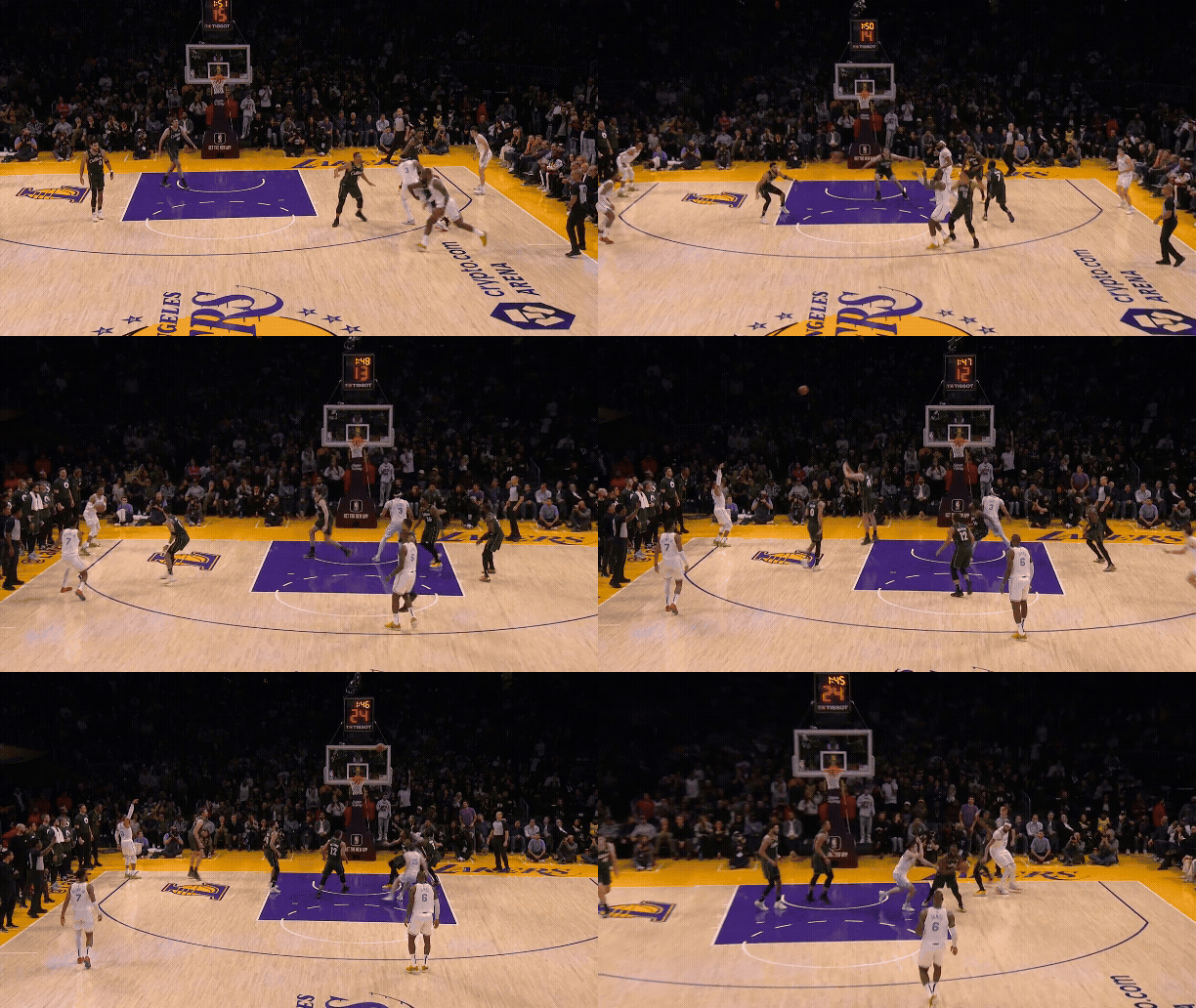
You won’t find this clip by looking at the shots Kornet defended. You’d only find it by watching every wide-open three taken with Luke Kornet on defense.
So that’s what I did.
Counting Eclipses
Teams have attempted 2,972 threes with Kornet on defense in the regular season since 2020. I briefly considered watching all 2,972 threes because I have a high tolerance for boredom. But I also knew that wasn’t required to answer the question at hand.
The appeal of the Eclipse is that it gives the defense a tool to contest an otherwise wide open shot. More often than not, these shots are taken when the nearest defender is more than six feet away from the shooter. Therefore, we don’t need to watch every shot attempt to track Eclipses. We just need to look at the wide-open ones.
There were 1,597 wide open1 threes taken with Kornet on defense in the regular season between 2020 and 2025. I watched all 1,597 over the course of a couple days and recorded each time I observed an Eclipse.
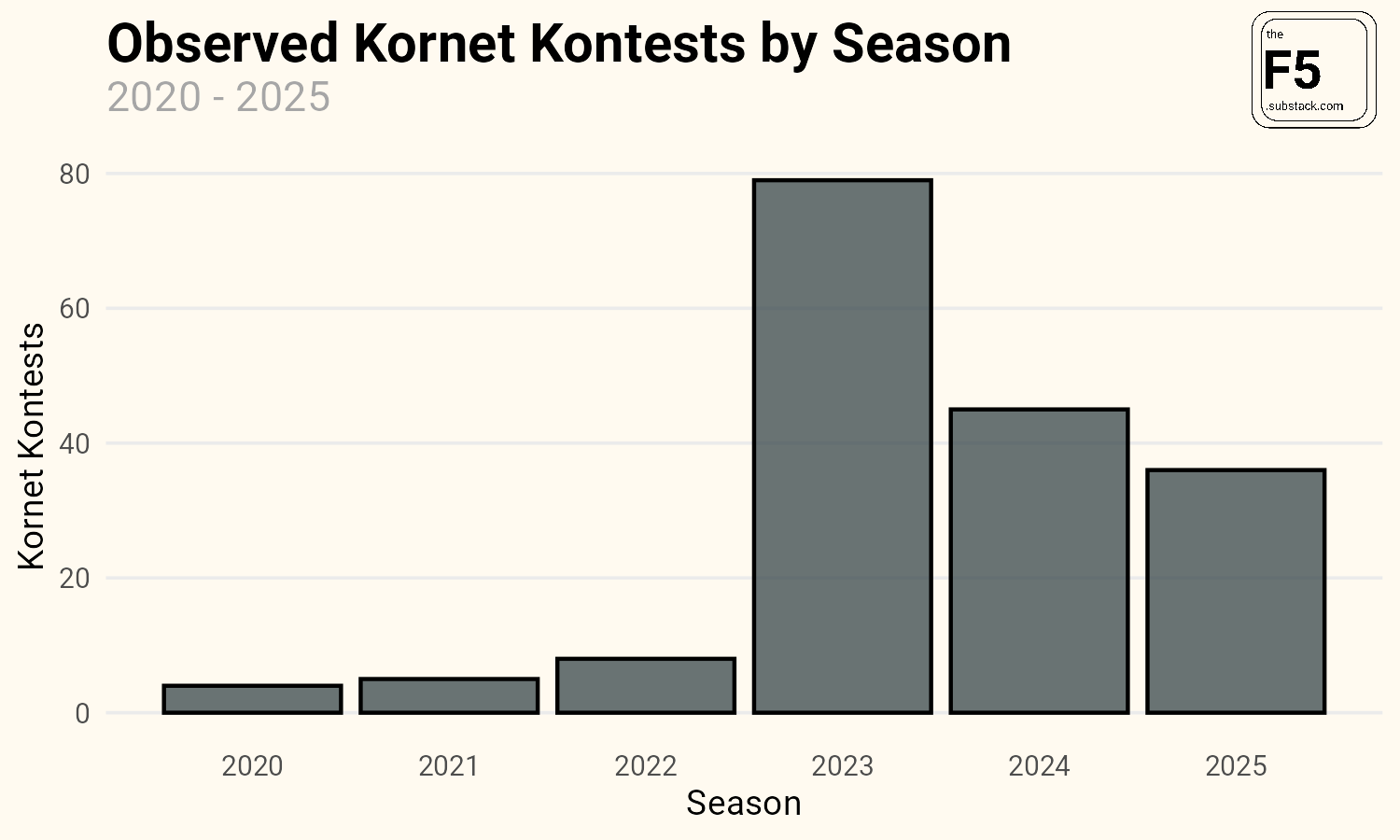
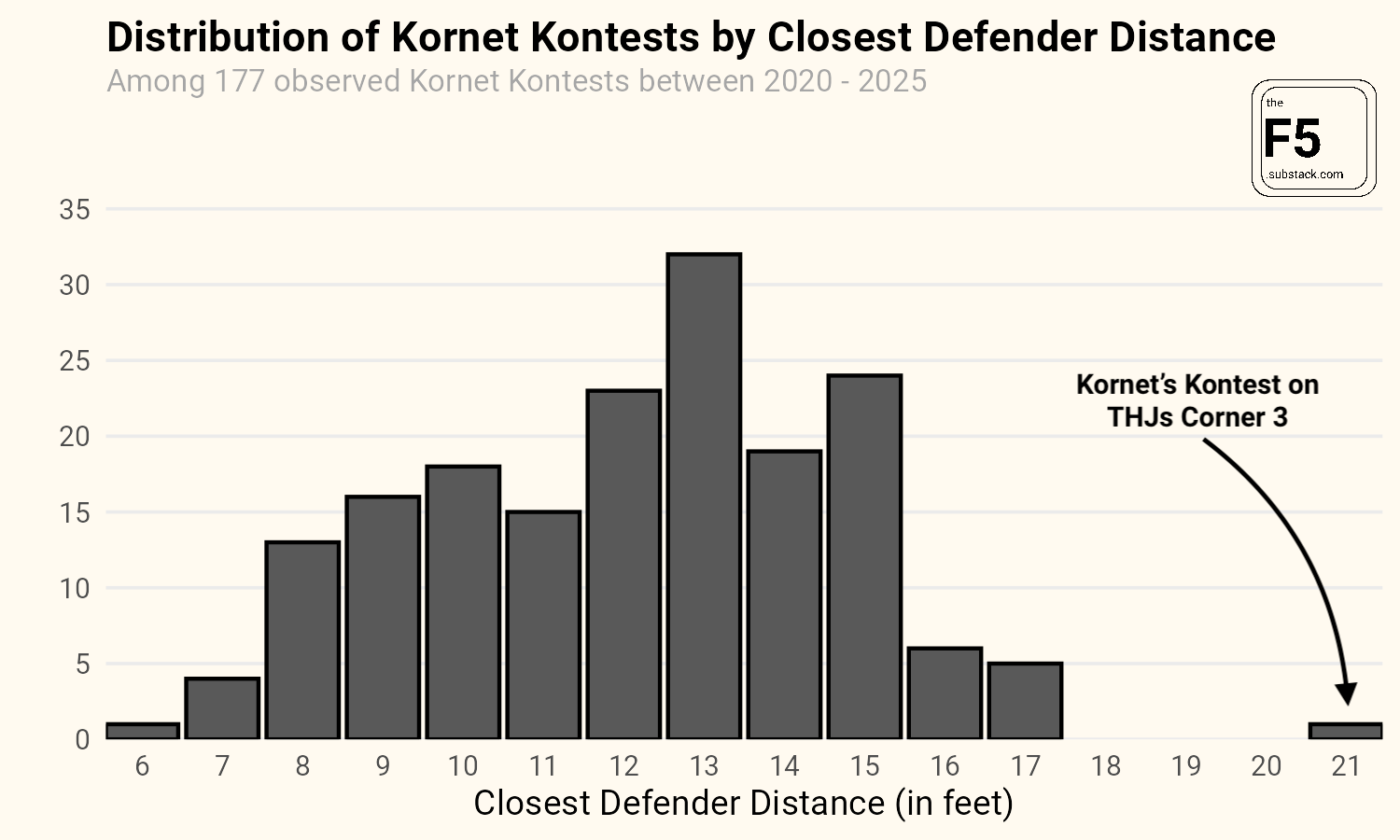
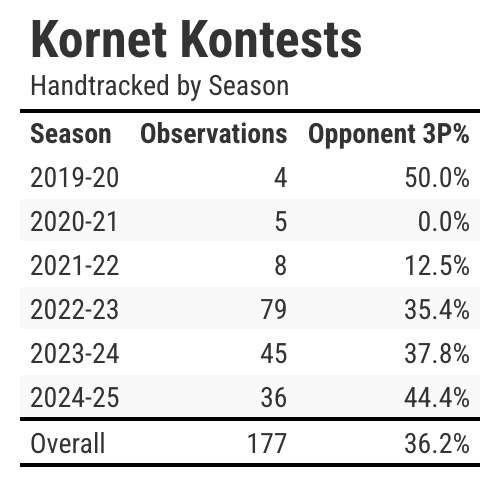
In total, I observed 177 instances of a Kornet Eclipse on opponent threes. Kornet was recorded as the closest defender about 70 percent of the time. The chart below shows my observed Kornet Kontests by season.
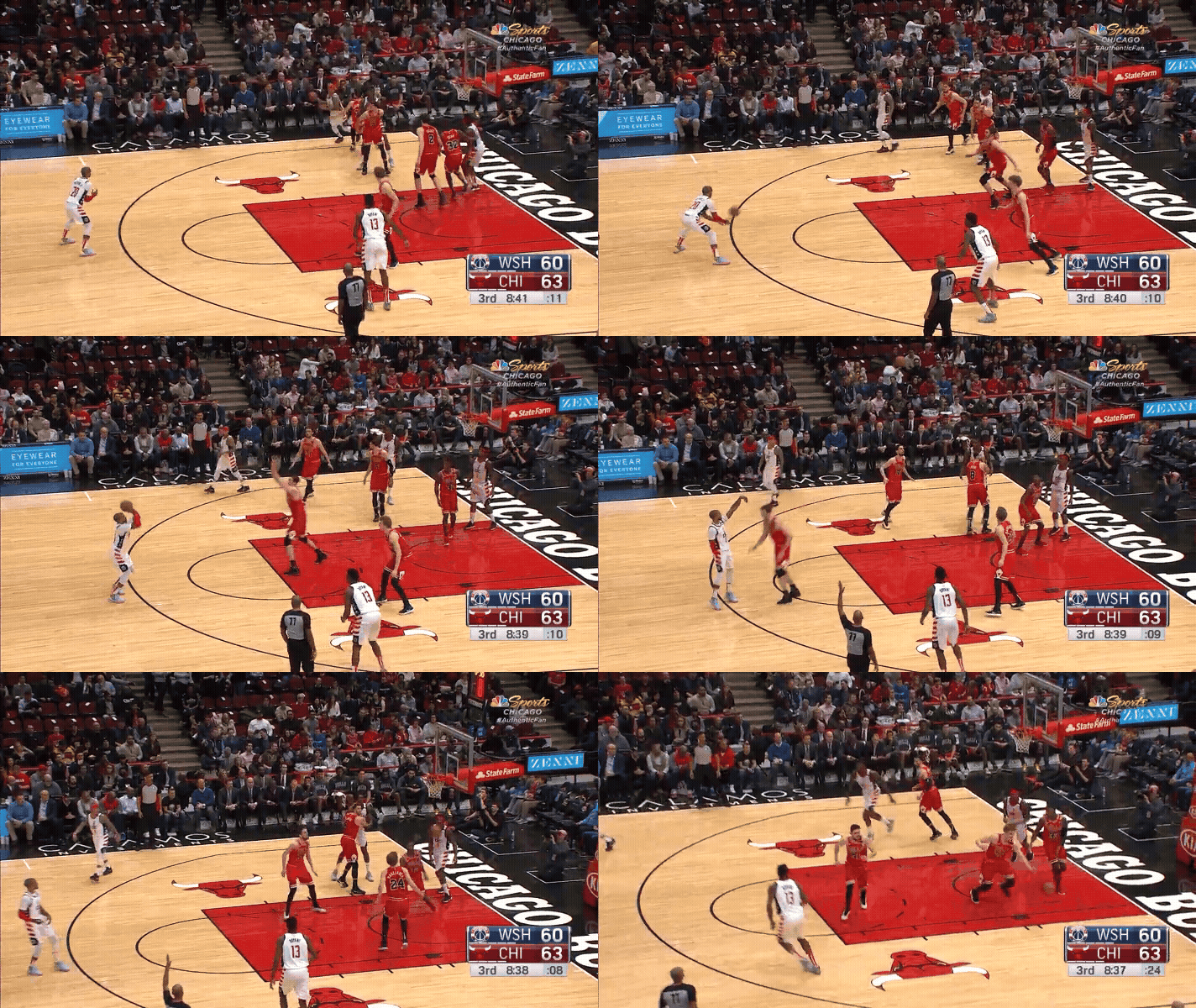
I associate Kornet’s Eclipse with Boston, but I found several instances of him performing the action as a member of the Chicago Bulls in 2020 and 2021. The earliest version of the Eclipse I came across was from a game in January of 2020.
Kornet began to close out to Gary Payton II at the top of the arc before taking off from the free throw line. He was too far away to block the shot but he may have obstructed Payton’s view of the basket. The shot came up short and Kornet’s legacy began to boom. There’s an alternate timeline where Payton doesn’t miss and Kornet never receives the positive reinforcement to continue innovating. Call it his eureka moment.
Kornet barely played 100 minutes in all of 2022 but still manages to log eight Eclipses, including five in one game against the Memphis Grizzlies in April 2022. All five of them came in garbage time of the fourth quarter while Boston was thumping Memphis. The Grizzlies, featuring Yves Pons, finished 1/5 against the Eclipse.
It wasn’t until the 2023 season that the Eclipse broke into the mainstream. That was Kornet’s first full year in Boston.
That season, I observed 79 different Eclipses, or a little more than one per game played for Kornet. Every media outlet under the sun ran a story about the Kornet Kontest including the following video essay from Brian Scalabrine, who jokingly claimed that the Kornet Kontest works every time.
Despite playing the most minutes of his career this past season, I observed Kornet performing just 36 Eclipses in 2025 — fewer than half as many from his peak in 2023.
To help validate my results, I reached out to Todd Whitehead and Sportradar to run a query on the raw 3D tracking data. I asked them if they could search their database for any instances of Kornet reaching both arms above his head with his thumbs close together while leaping off the ground to “Korntest” a wide open three. The query returned 81 matches from the past two seasons combined — just two more than what I found from my hand tracking.
Whitehead and Sportradar were kind enough to share the exact X,Y coordinates that came with the query, which allowed me to plot the location of each Eclipse on the court from the past two seasons.
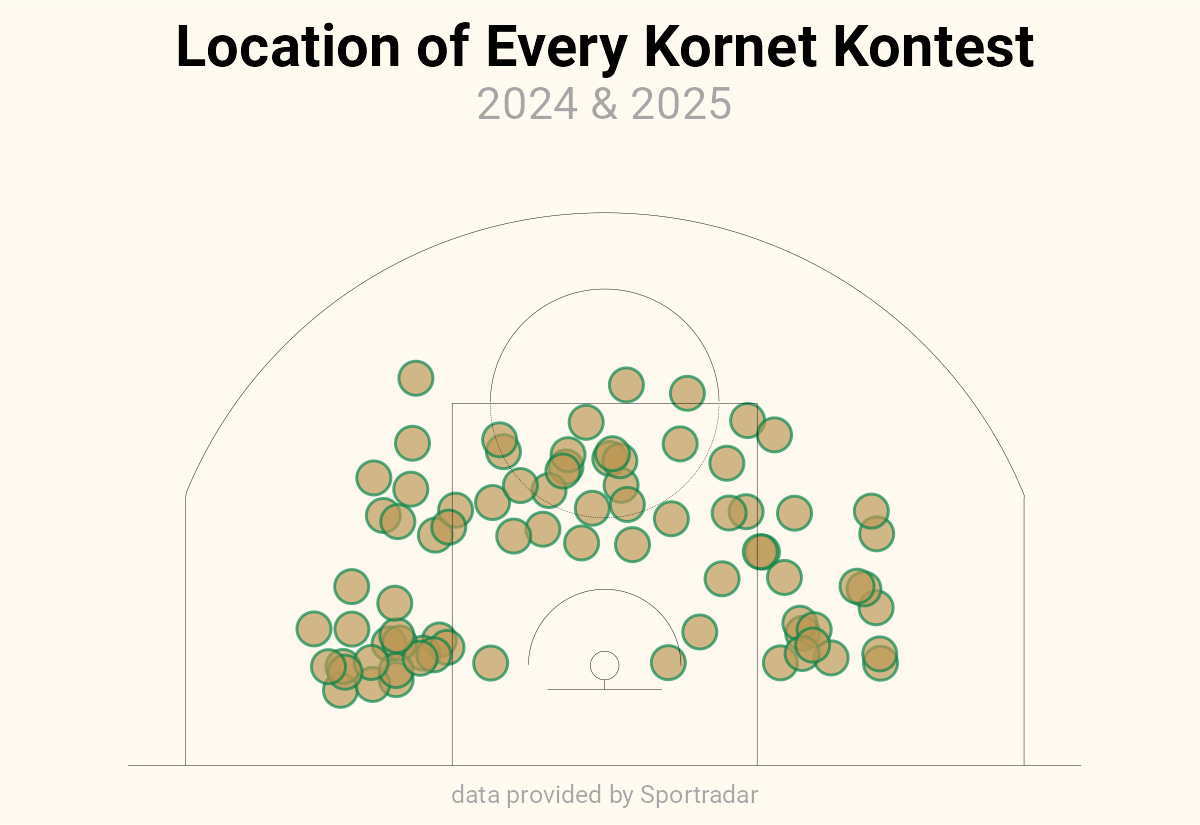
The chart above shows where on the court Kornet jumped up from while contesting an open three. There’s a concentration of points in both short corners (the area near the baseline between the corner three and the basket), indicating where Kornet sprang from to block the view of a three-point shooter.
My favorite example that you can see in the chart is when Kornet jumped from inside his own restricted area to distract Talen Horton-Tucker on a corner three.
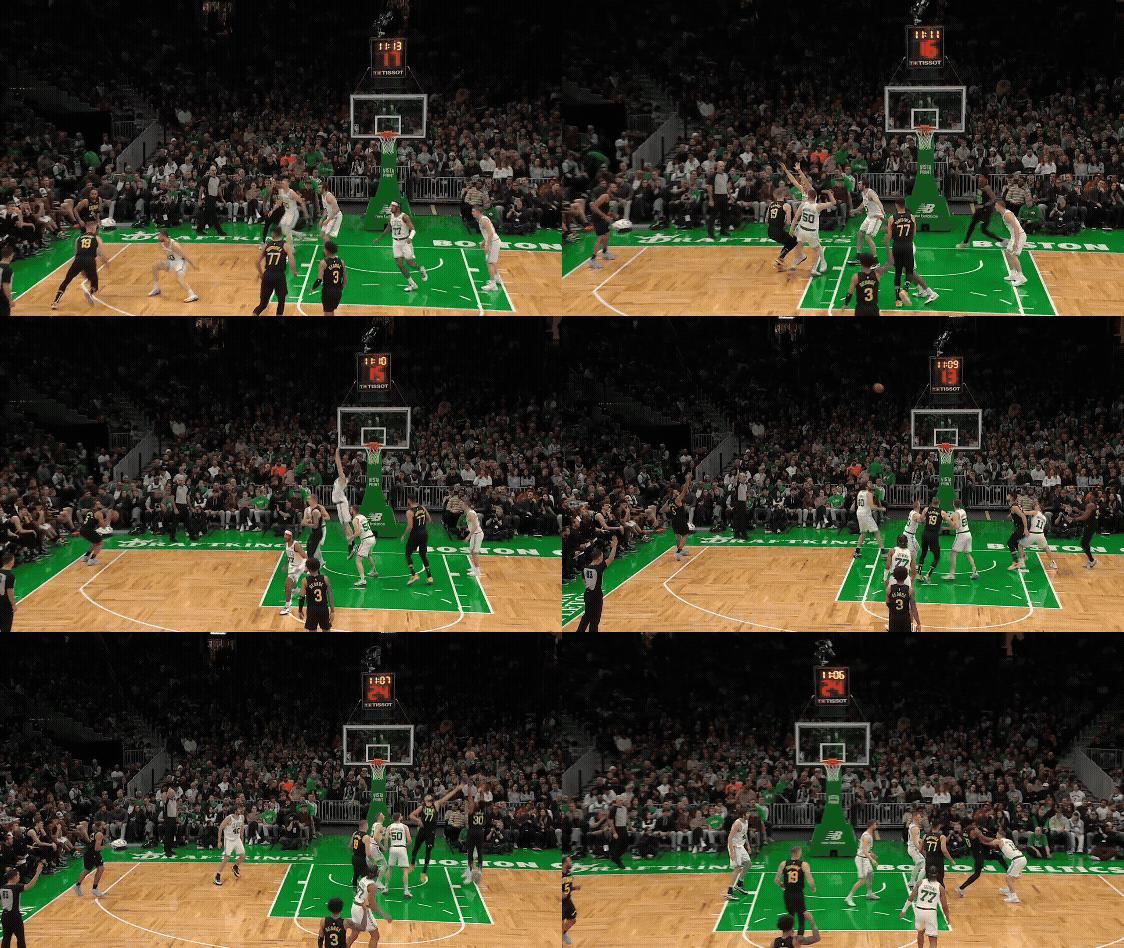
It came from more2 than 21 feet away from THJ, further away from the shooter than any other Eclipse I observed between 2020 and 2025.
Open for a reason
By my count, opponents shot 36.2 percent from three against the 177 Eclipses I observed between 2020 and 2025.
The league average accuracy on wide open threes between 2020 and 2025 was 38.8 percent.
At first blush, it would appear then that the Eclipse is responsible for reducing wide open three-point accuracy by more than two and a half percentage points. That might not sound like a big deal, but it could make a meaningful difference in a team’s performance over the course of a season.
For context, OKC’s opponents shot just 37.2 percent on wide open threes last season. That was the lowest mark in the league and helped the Thunder produce one of the greatest defensive seasons of all time.
But there are a two issues with our results.
First, shooters got progressively better at making threes in the face of the Eclipse, which supports what Dean Oliver and the Wizards’ coaching staff found when they tested the Eclipse in practice. This might explain why Kornet has slowly started to phase out the Eclipses the past two seasons.
The second, and more pertinent problem, is that the kind of shooter that’s wide open enough to face an Eclipse is not random. These players tend to be worse shooters on average. They are wide open for a reason.
For example, the two players that have seen the most Eclipses are Russell Westbrook and Anthony Gill. Each player has faced five Eclipses and is a combined 2-for-10 on their attempts. That’s not surprising given that both Gill and Westbrook are career 30 percent three-point shooters.
To put it another way, our sample of shooters is biased. It’s not representative of the league as a whole so comparing their numbers to league averages isn’t helpful.
To try to disentangle the effect of the Eclipse from the quality of the shooters themselves we need a better apples-to-apples comparison. Otherwise we can’t say for certain if the Eclipse actually works as advertised or if it’s just shitty shooters shooting shittily.
To better understand what (if anything) the Eclipse is doing, I calculated each NBA player’s career average on wide open threes3 and weighted it by how often the player faced an Eclipse4. This weighted figure produces a reasonable estimate of what we would expect our sample of players to shoot on normal wide-open threes.
If the Eclipse actually works, then our sample of shooters should perform worse when facing it than they typically do on wide-open threes.
tl;dr
Players shot 36.2 percent from three against 177 Eclipses. That’s below the league average on wide-open threes (38.8 percent), but it’s within the ballpark we’d expect from our sample of shooters whose career weighted average on wide open threes is 35.4 percent. Meaning, our sample shot about as poorly against the Eclipse as they do on any other kind of wide-open three-point attempt.
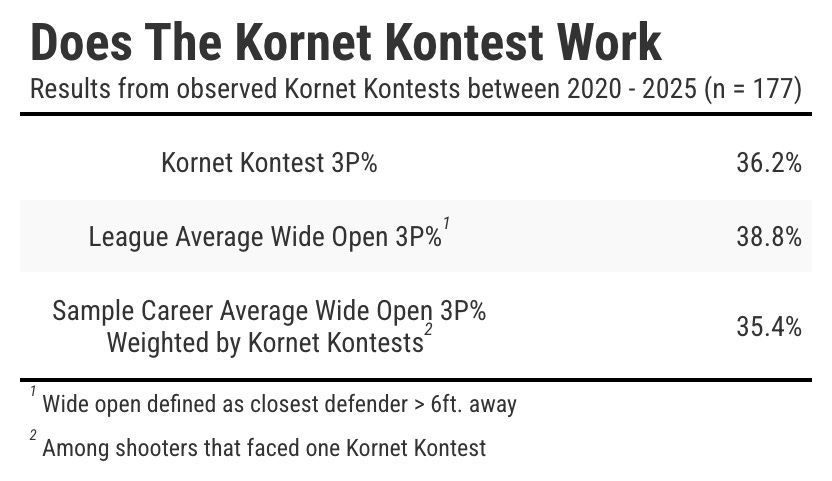
To summarize, an Eclipse will usually feature a bad shooter — but I don't think it necessarily makes players shoot bad. Since it tends to be used against poor shooters, it has the effect of looking more impactful than it probably is.
However, there is no on-court cost to performing an Eclipse. At the outset of this research, I wondered if an Eclipse might lead to more offensive rebounds for the opposition because it takes Kornet out of rebounding position, but my tally suggests otherwise. After a successful Kornet Eclipse (a missed shot), opponents collected about 18 percent of potential offensive rebounds, about two percentage points lower than in similar situations.
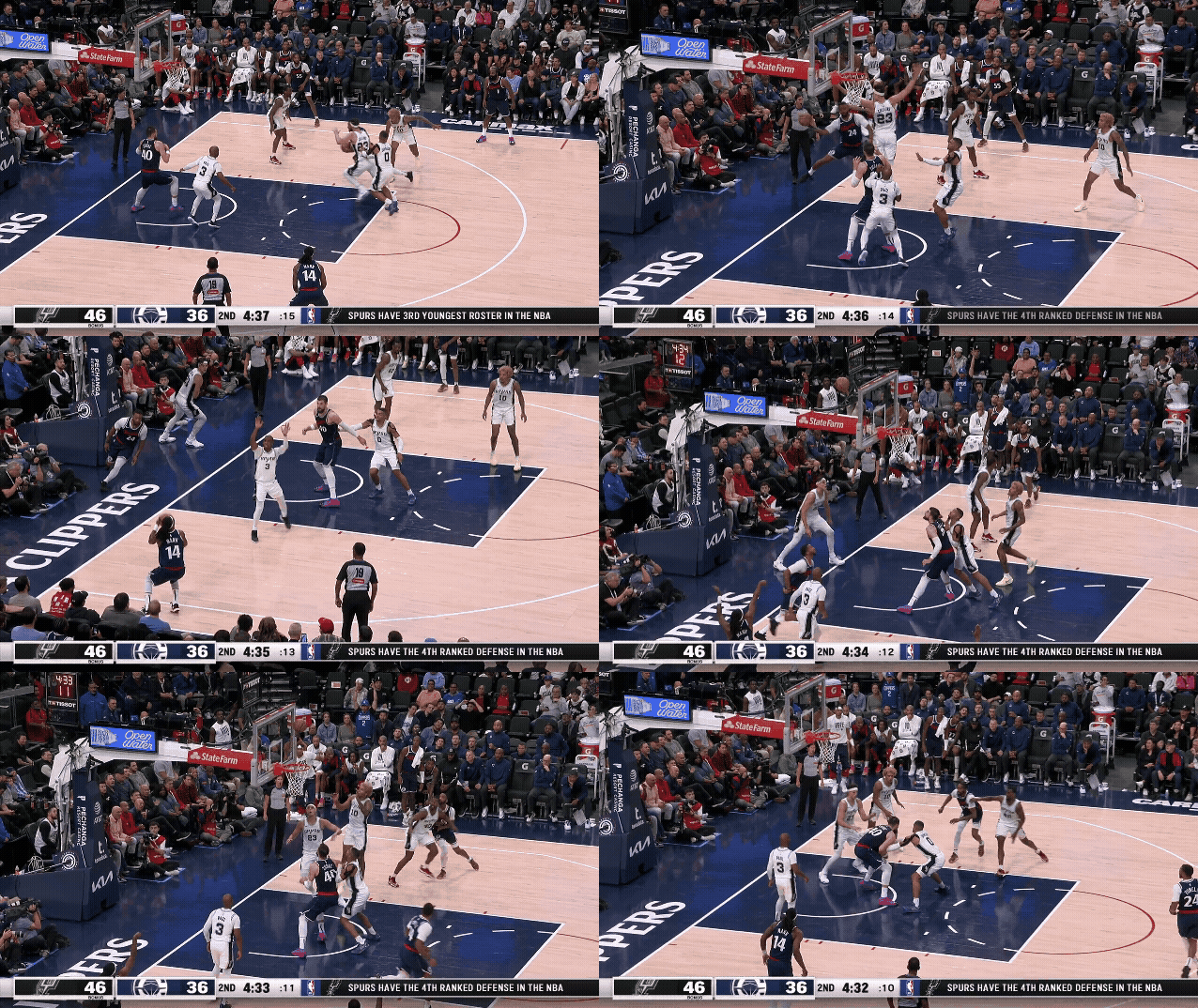
So maybe all this means is that players like Kornet shouldn’t stop experimenting. If it’s cost-free, why not add some flair to the Eclipse and see what sticks? Chris Paul, the master of gamesmanship, claps his hands at the apex of his partial Eclipse. Maybe Kornet could try that while making fart noises in the general direction of the shooter.
Postscript
Ending on a null result is never the most satisfying conclusion. It’s not going to generate headlines and this post won’t hit two million views. It would have been a lot flashier (and easier to write) if the results showed the Eclipse having a real and measurable impact.
So what did we learn, reader? I don’t know. I guess we learned not to do the Eclipse again.
Some links
Defined as the closest defender more than six feet away.
Sam Hauser was technically the closest defender to THJ at around 21 feet. Kornet appears to be about two or three feet further away from the shooter than Hauser was.
this is what Seth Partnow refers to as the Shooter Quality Index.
In practice, that means Westbrook’s career averages get weighted five times more heavily than the career averages for someone who has only faced one Eclipse in my dataset.
Very fun and great article. I hope we will see at least one instance of Kornet-Wemby "Double Eclipse" this season.
Great story Owen, and thanks for the shout out! One argument against the Kontest that I've heard (either from a player or head coach, can't remember) is that players can pump fake, then drive past it if they know it's coming. I haven't noticed it happening, but food for thought.